Care that lasts.
A knife or a board needs very little, but it needs the same few things every time. Wash, dry, hone, oil and store: do those and your tools will outlast most of what is in the kitchen.
Cleaning and drying knives
Most damage to a good knife happens after the cooking is finished. A few seconds of care at the sink makes a very large difference.
- Wash by hand soon after use, in warm water with a little mild washing-up liquid. Use a soft cloth or sponge, with the edge facing away from you.
- Rinse and dry straight away with a soft cloth. Wipe from the spine side, not along the edge.
- Dry the handle as well. Timber handles should never be left to soak.
- Never put a knife in the dishwasher. Heat, detergent and knocking against other items damage the edge and the handle.
Carbon steel
Carbon steel knives are not rustproof. They develop a grey-blue patina with use, which is normal and protective. Wipe the blade clean when you move between onions, citrus, tomatoes or other acidic foods, and dry it at once after washing. If the knife will be stored for a while, wipe on a very thin film of food-safe oil.
What to cut on
Use timber or soft synthetic boards. Glass, stone, ceramic and steel surfaces dull the edge within a few uses. Avoid bones, frozen food and hard shells.
Sharpening and honing
These are two different jobs. Honing realigns a bent edge and removes almost no steel. Sharpening removes steel to create a new edge when the old one has worn away.
Honing
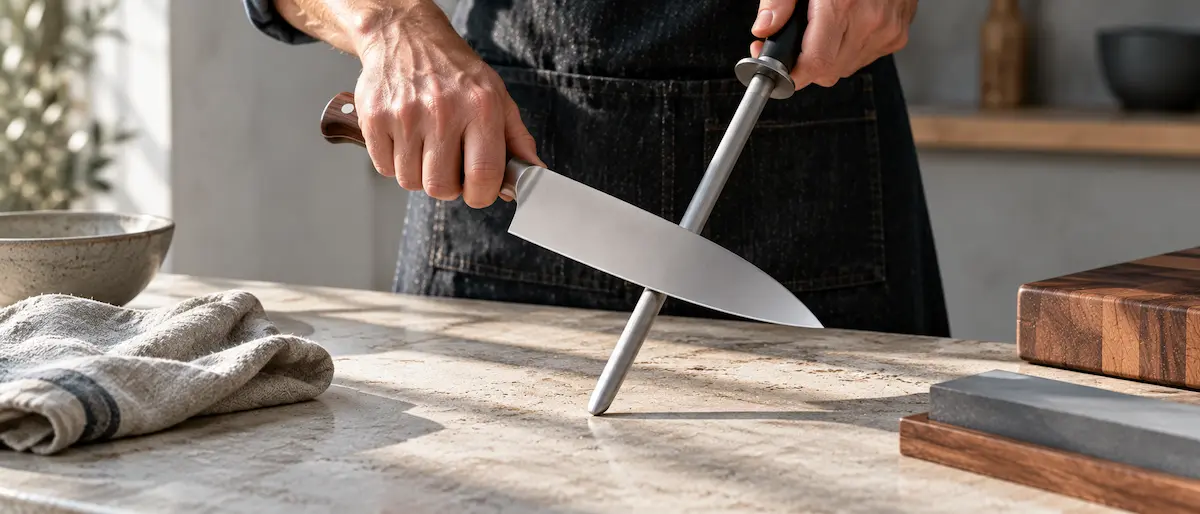
- Use the honing or maintenance method appropriate for your particular knife and its edge, following its individual care guidance.
- If using a fine honing rod, rest its tip on a stable surface and follow the knife’s specified edge angle; geometry varies by model.
- Draw the blade down the rod from heel to tip with light pressure, then repeat on the other side. Five or six strokes each is plenty.
Sharpening
- Use a whetstone for the best results: a combination stone of around 1000 grit on one side and 3000–6000 on the other suits most home cooks.
- Keep a steady angle, work from heel to tip and continue until you feel a thin burr along the opposite side of the edge. Repeat on the other side, then refine on the finer stone.
- Typically a few times a year for a household that cooks daily. Carbon steel sharpens quickly and is easy to maintain.
- Avoid pull-through and electric sharpeners on fine blades: they remove a lot of steel and can leave a rough edge.
A fuller walk-through is in our journal: Keeping your kitchen knife sharp.
Knife storage
- Store in a blade guard, a knife block or on a magnetic rack. Never loose in a drawer, where edges knock against other tools and fingers find them by surprise.
- On a magnetic rack, place the knife spine first and let the edge meet the surface gently, so it is not chipped by the magnet.
- Mount racks on a solid wall, with fixings suited to the wall type, and out of the reach of children.
- Store knives dry and, for carbon steel, lightly oiled if you will not use them for a while.
Caring for wooden boards
- Wipe or wash with a cloth, warm water and a little mild detergent straight after use. Rinse and dry with a cloth.
- Never soak a board, put it in a dishwasher or leave it sitting in water.
- Stand the board on its edge to air-dry so both faces dry at the same rate, away from radiators, ovens and direct sunlight.
- Turn the board regularly so wear is spread evenly.
Stains and odours
Sprinkle coarse salt over the board and scrub with half a lemon. Rinse, dry and re-oil. For stubborn marks, a very light sanding with fine paper refreshes the surface; oil afterwards.
Oiling and maintaining timber
Oil replaces the moisture and natural oils that wash out of the timber and slows the absorption of liquids and odours.
- Use food-safe mineral oil or a board conditioner of mineral oil and wax, such as our Board Conditioning Oil.
- Avoid cooking oils such as olive or sunflower oil. They can turn rancid and leave a sticky surface.
- Apply to a clean, dry board. Spread a thin coat along the grain with a lint-free cloth, including edges and both faces. Leave for several hours or overnight, then wipe off the excess.
- Test with a few drops of water. If they bead, the surface is protected; if they soak in, it is time to oil.
- New boards and end-grain boards need oiling more often, perhaps monthly at first. Timber handles need oil once or twice a year.
Preventing warping
Warping and cracking come almost entirely from uneven moisture. Timber that gets wet on one side and dries on the other bends towards the drier face.
- Dry both faces evenly and stand the board on edge.
- Keep boards away from heat sources and direct sunlight.
- Oil both faces, not just the one you use.
- Do not soak or dishwash. This is the single most common cause of damage.
- If a board begins to cup, rest it hollow side up for a day or so. Mild cases can improve; a severe warp will not reverse.
Food hygiene and safe handling
- Use a separate board for raw meat and fish, and another for ready-to-eat food. Wash the raw board promptly in hot, soapy water.
- Wash your hands, knives and boards when you move between raw and cooked food.
- A well-kept timber board that is washed and dried properly is a good surface for food preparation. Stop using a board that has split in a way that traps food.
- Cut away from yourself, keep fingers curled behind the blade in a claw grip, and use a damp cloth under the board to stop it moving.
- Never try to catch a falling knife. Step back and let it fall.
- Carry a knife with the point down, edge facing back and away from you, and say so when walking through a busy kitchen.
Knives are age-restricted products and should be kept out of reach of children.