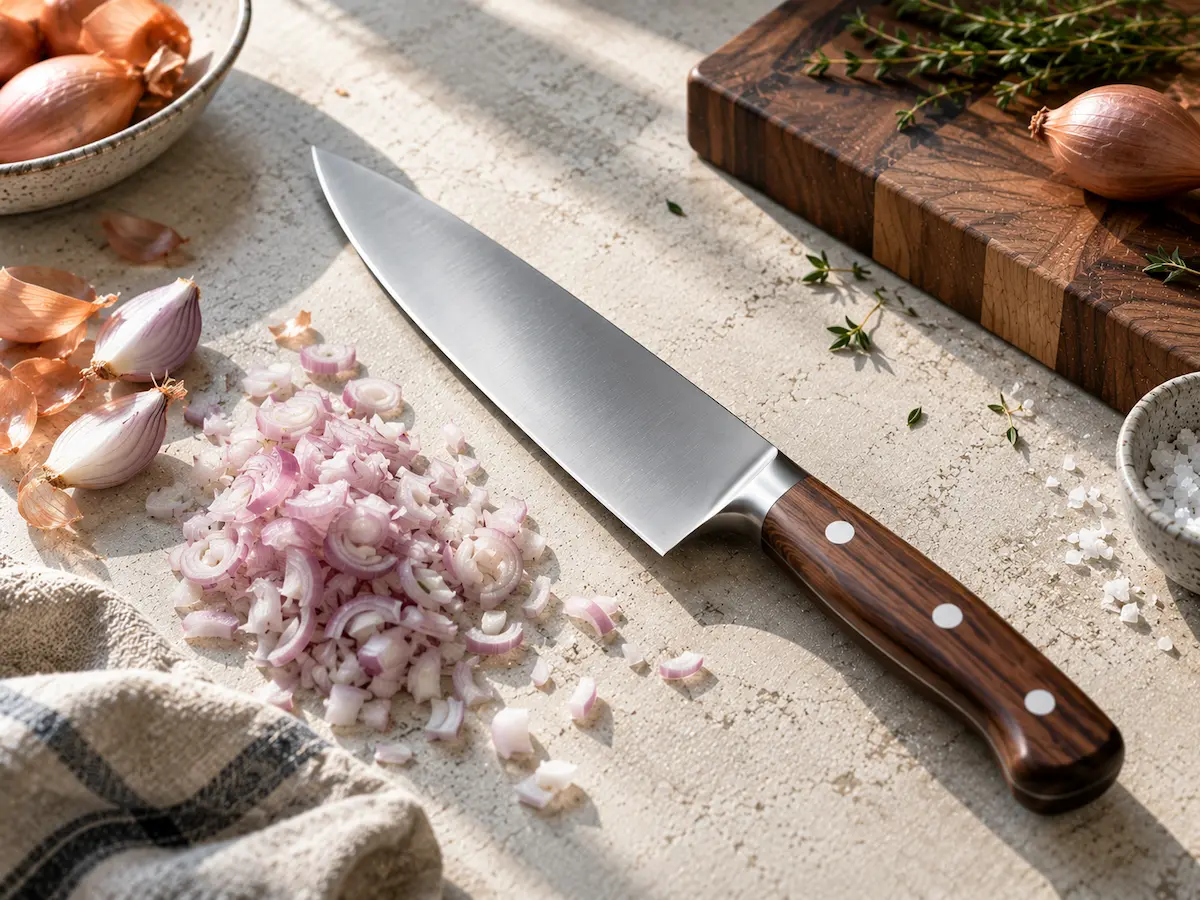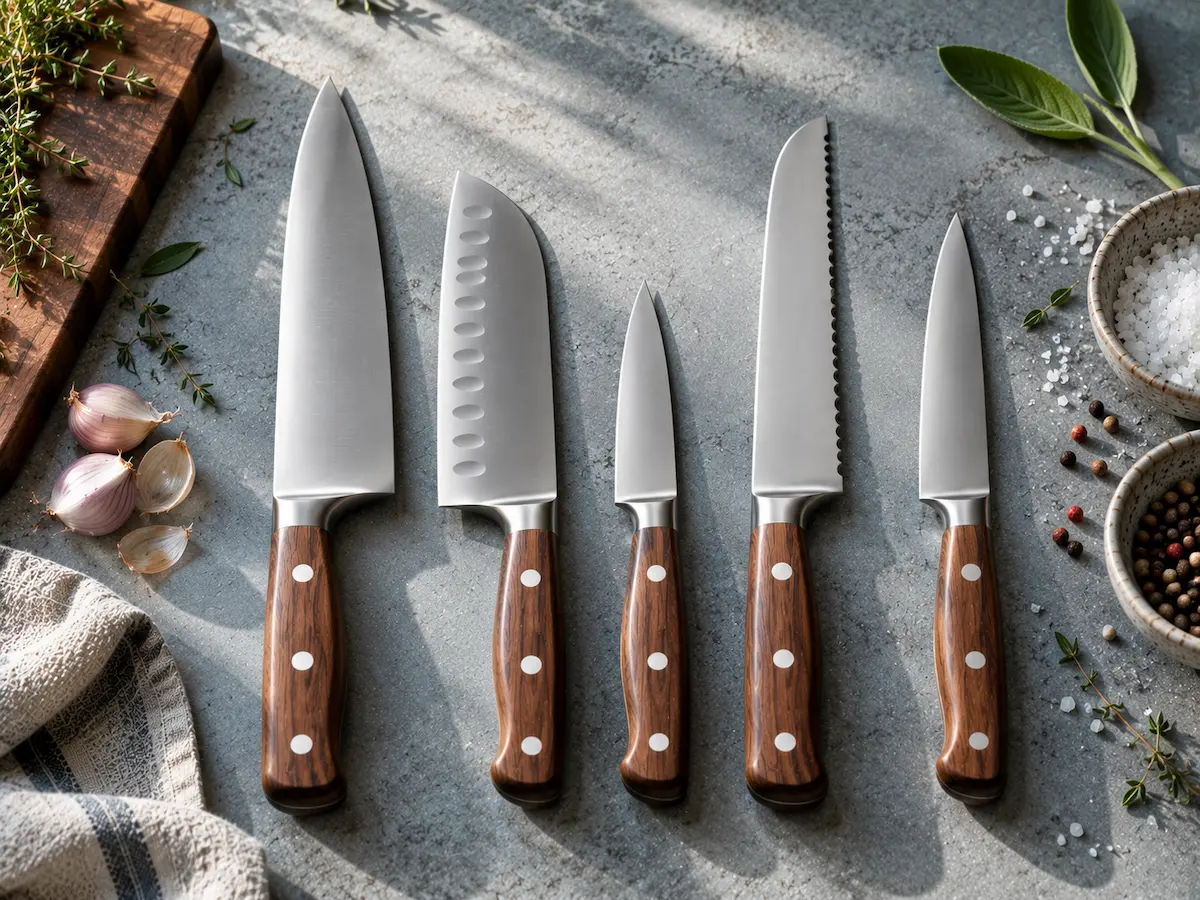
A sharp knife is safer and more pleasant to use than a dull one. It needs less force, follows the line you intend and is less likely to slip. Keeping an edge in good condition is a matter of two quite different tasks: honing and sharpening.
Honing and sharpening are not the same
With use, the very fine edge of a knife does not wear away so much as bend slightly out of line. Honing pushes it back into alignment and removes very little steel. Sharpening removes steel to create a new edge when the old one has worn away.
If your knife feels dull, honing is the first thing to try. If honing no longer helps, the knife needs sharpening.
Honing
Use a fine honing rod, held with the tip resting on a stable surface. Place the heel of the knife against the top of the rod at the same angle as the edge, around 15°, which is a little less than 20° and a little more than a flat blade. Draw the blade down and across the rod toward the tip, using light pressure. Repeat on the other side, five or six strokes each.
Hone before or after each session of cooking if you can. Ceramic rods are gentler than steel ones; very hard steels and thin edges suit a fine or smooth rod.
Sharpening on a whetstone
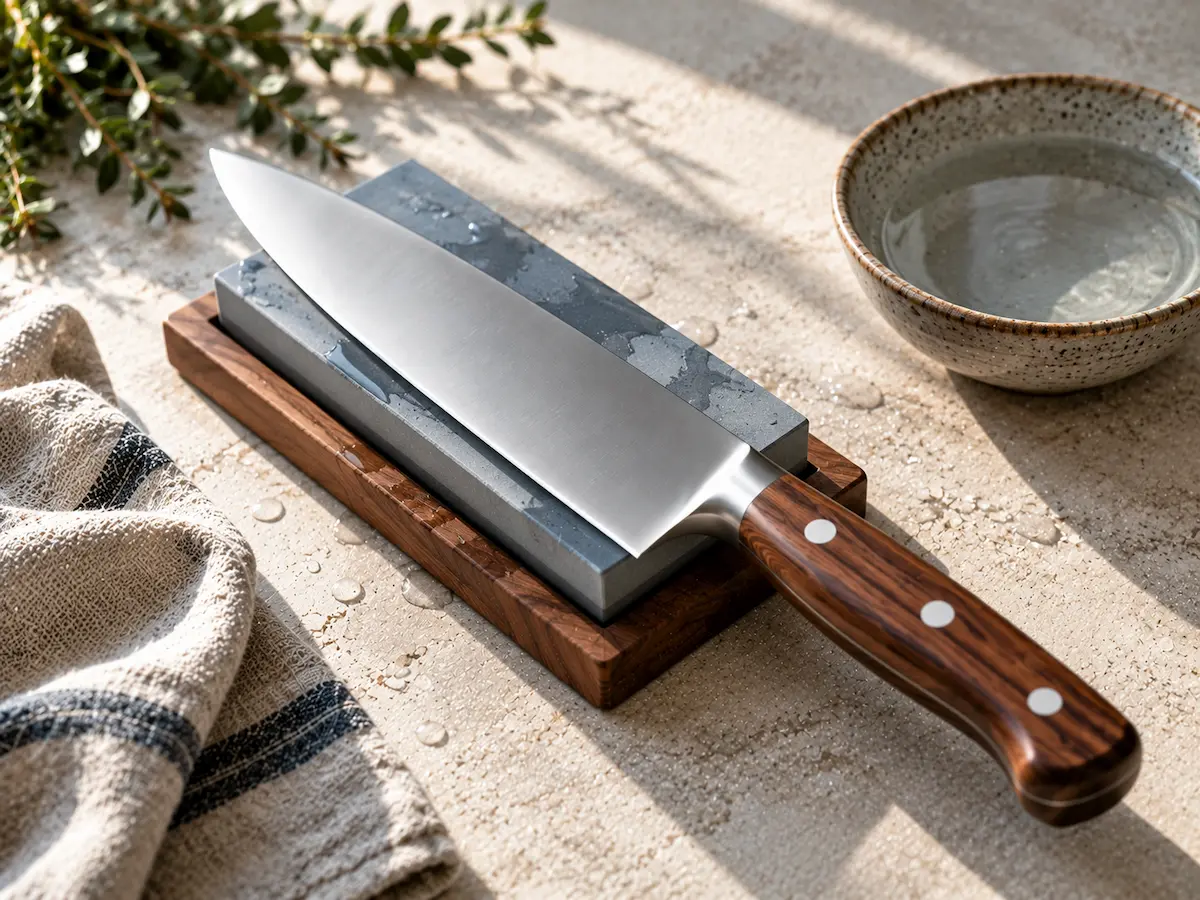
A whetstone gives the best results and the most control. A combination stone with a coarser side of around 1000 grit and a finer side of 3000–6000 is enough for most home use. Soak the stone or splash it with water according to its instructions, and set it on a damp cloth so it does not move.
- Hold the knife at the angle of its existing edge and keep that angle steady; check the individual specifications because edge geometry varies by model.
- With light pressure, push the edge across the stone as if you were slicing a thin layer from it. Work from heel to tip.
- Continue on one side until you feel a thin burr, a tiny lip of metal, along the opposite side of the edge.
- Turn the knife over and repeat until the burr moves to the other side.
- Move to the finer stone and use lighter strokes to refine the edge.
- Finish with a few very light alternating strokes, then wipe the blade and test it.
Stropping
A strop, which can be as simple as a piece of leather or card, removes the last of the burr and polishes the edge. Draw the knife away from the edge, spine first, with very light pressure.
How often
It depends on how much you cook. A household that cooks daily will probably want to hone every few uses and sharpen every few months. Carbon steel often sharpens quickly and is easy to maintain. If you cut mostly on a timber board and keep the knife dry, you will sharpen less often than someone who uses a hard surface.
What to avoid
Pull-through sharpeners remove a lot of steel quickly and can leave a rough, uneven edge, so they are best avoided on fine blades. Electric sharpeners can remove too much metal and heat the edge. Never use a knife on glass, stone or ceramic, and keep it away from bones and frozen food.
If you do not want to sharpen your own knives, a professional sharpener is a sensible option. Ask whether they work by hand on stones and how they handle thin, hard blades.
Safety
Keep your fingers well away from the edge, work slowly and use a stable surface. Wipe the blade with the edge turned away from you. Store your knife safely afterwards, in a guard, a block or on a magnetic rack.