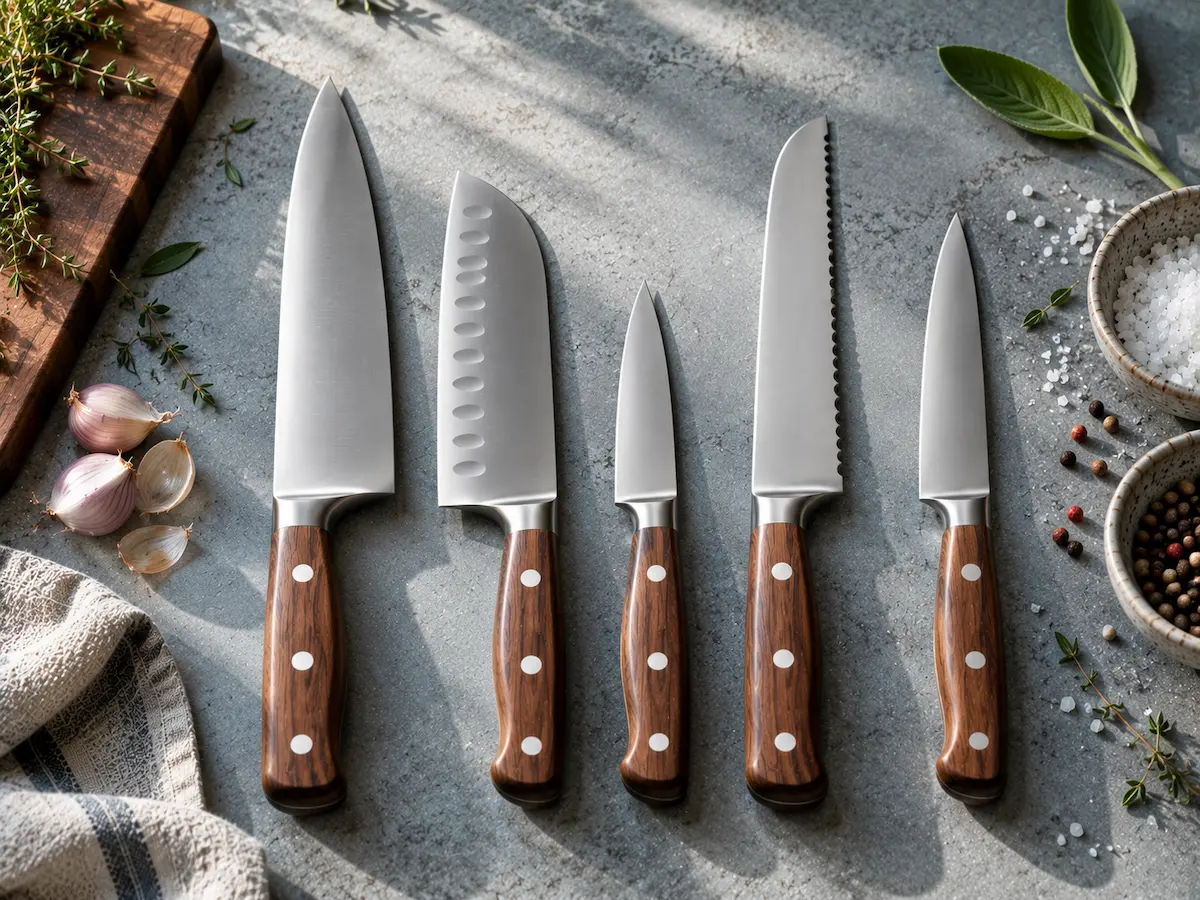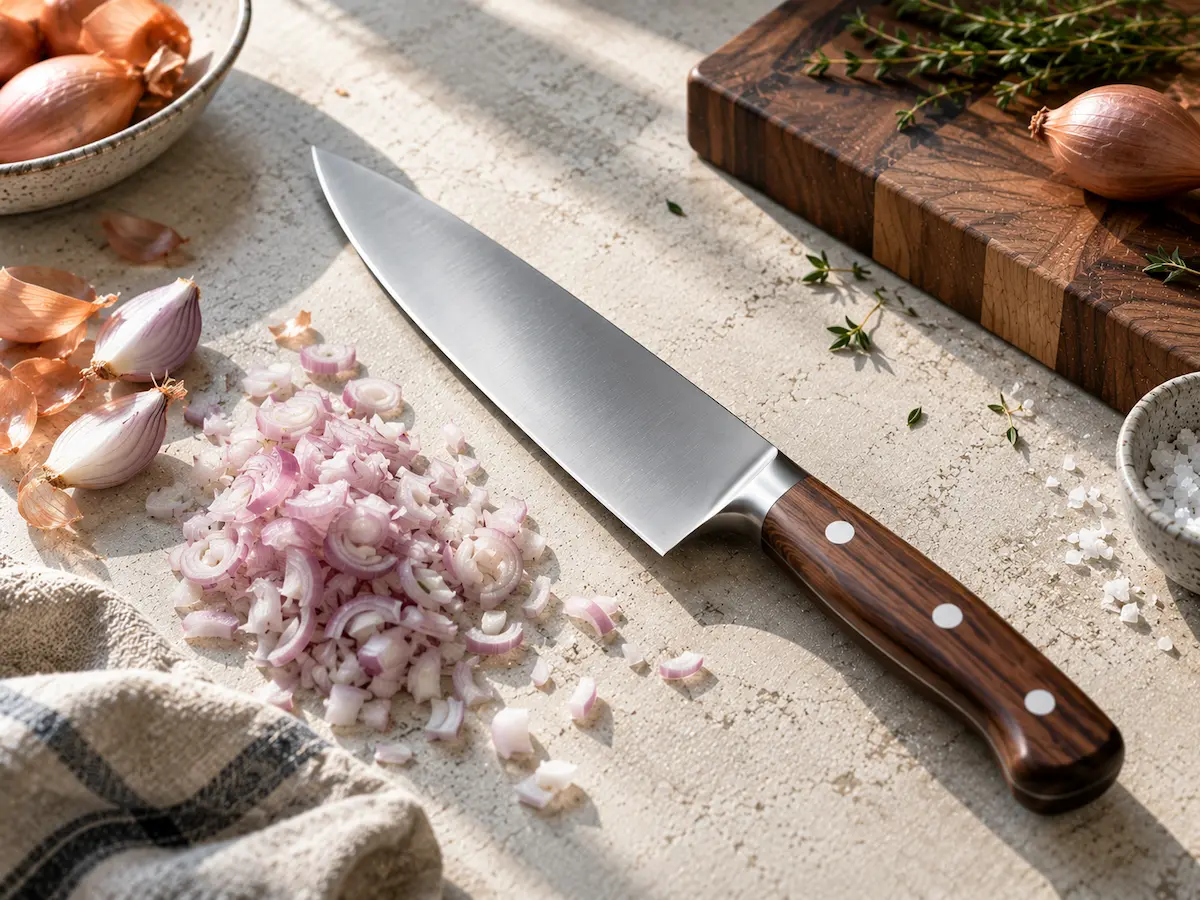
A chef’s knife is the tool you will use more than any other in the kitchen. Choosing a handmade one is not about finding the most expensive or the most impressive. It is about finding the one that suits your hands, your board and your habits, so that it gets used every day.
Start with how you cook
Before you look at steel or handles, think about what you actually prepare. A cook who chops vegetables most evenings has different needs from someone who butchers a chicken at the weekend or slices a roast. Most everyday work is vegetables, herbs, onions, boneless meat and fish.
It also helps to think about the board you have. A long blade on a small board is awkward, because there is nowhere for the blade to travel. A large board and a small knife is not a problem, but you may find yourself wishing for more reach.
Length
Chef’s knives are usually sold in lengths from 180 mm to 270 mm. For most home cooks, 200–210 mm is the sweet spot: long enough to slice and rock comfortably, short enough to control precisely and to store easily.
- 180 mm: nimble, good for smaller hands and smaller boards, less reach for large vegetables.
- 210 mm: the most versatile length, suitable for nearly everyone.
- 240 mm and over: long strokes and extra reach for cooks who prepare large quantities, but it needs space and confidence.
Weight and balance
A lighter knife is less tiring and quicker to move. A heavier knife does more of the work for you through gravity. Neither is better; it is a matter of preference.
Balance is as important as weight. Most cooks hold a chef’s knife in a pinch grip, with the thumb and forefinger on either side of the blade just ahead of the handle. Pick the knife up in that grip. If it feels as though it is tipping forward or backward, it will feel that way after an hour of chopping.
Stainless or carbon steel
Stainless steels such as AEB-L and 14C28N resist rust and need little attention beyond washing and drying. They take a fine edge and are the sensible choice for most households.
Carbon steels such as 80CrV2 can be sharpened more quickly and often feel slightly crisper on the board. They are not rustproof. They develop a grey-blue patina, and they need to be dried straight after use. Some people enjoy that relationship with their knife; others find it a chore. Be honest about which you are.
Blade shape
A western-style chef’s knife has a curved belly that suits a rocking motion: the tip stays on the board and the heel rises and falls. A flatter profile suits push cuts and a chopping action. You can read more in our guide to knife shapes. If you are unsure, a moderate belly will do both.
Also look at blade height at the heel. A taller blade gives your knuckles clearance above the board; a shorter blade is lighter and more delicate.
The handle
Handle shape makes a surprising difference. Octagonal and oval handles sit well in most hands. Timber is warm and slightly grippy, particularly when oiled. Look for smooth transitions where the handle meets the blade and no sharp edges anywhere.
Timber handles should not be soaked or put in a dishwasher, but with ordinary care they last for many years and can be re-oiled whenever they look dry.
What you are paying for
In a handmade knife you are paying for the time spent on grinding and finishing, for the quality of the steel and heat treatment, and for the fit between blade and handle. These are things you notice when you use the knife: how the edge goes through a tomato, how the spine feels under the thumb, how the handle feels at the end of a long session.
You do not need to spend at the top of a range to get a good knife. A well-made 210 mm knife in a sensible steel is a better first purchase than an exotic blade you are afraid to use.
Be ready to look after it
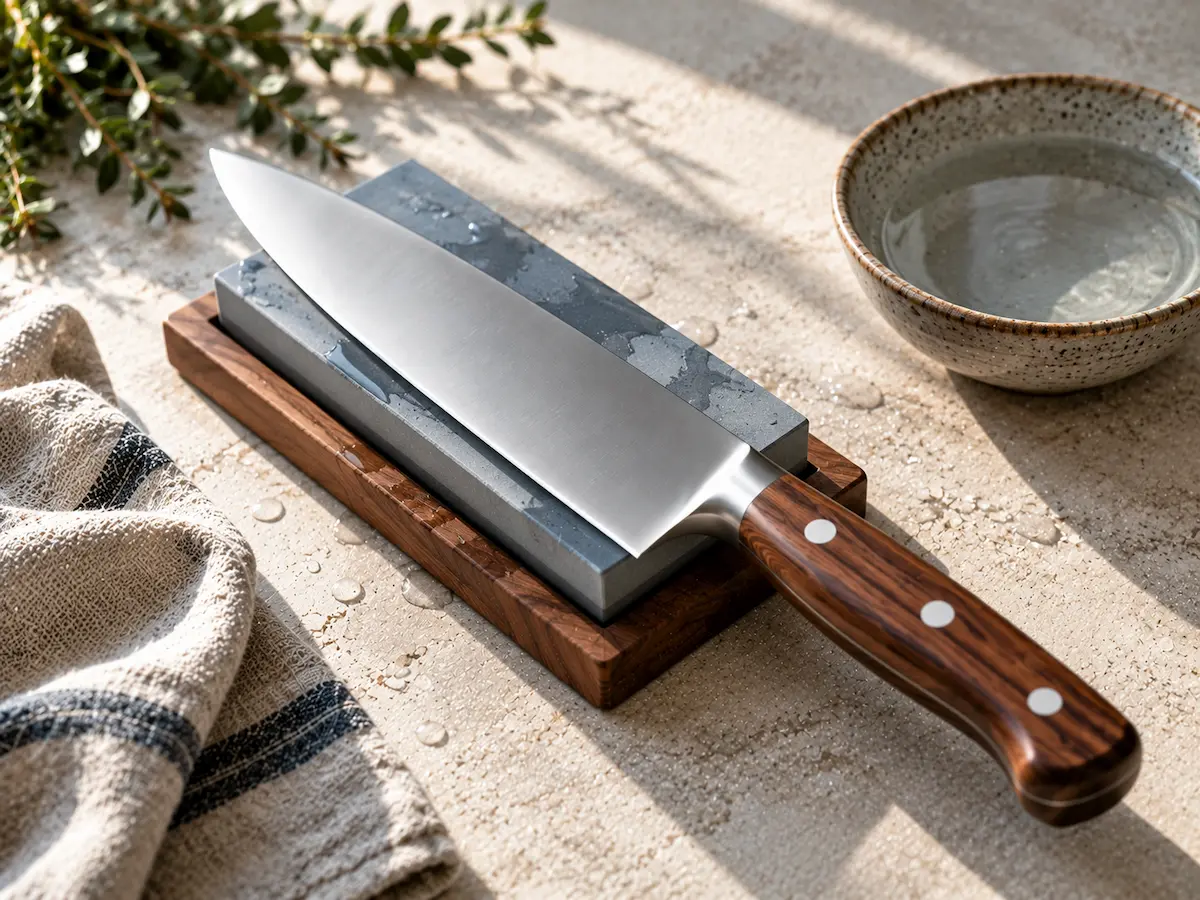
A sharp knife is a safer knife, but it will not stay sharp by itself. Plan to hone it regularly and to sharpen it a few times a year, depending on how much you cook. Our guide to keeping a knife sharp explains how. Use a timber or soft synthetic board, hand wash and dry, and store it somewhere the edge is protected.
Finally, remember that knives are age-restricted products. We check age and identity at purchase and at delivery.